



John Pawson
the architect who made emptiness the most coveted thing in a room.
- Store 7
- Learn 0
- Travel 8
- Event 0

Read the Stoy

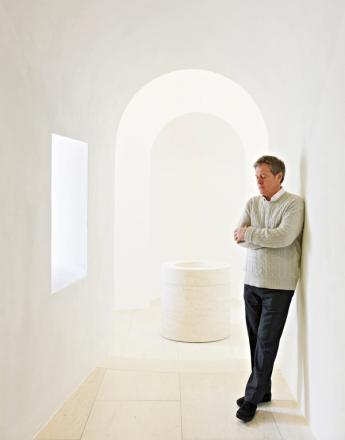
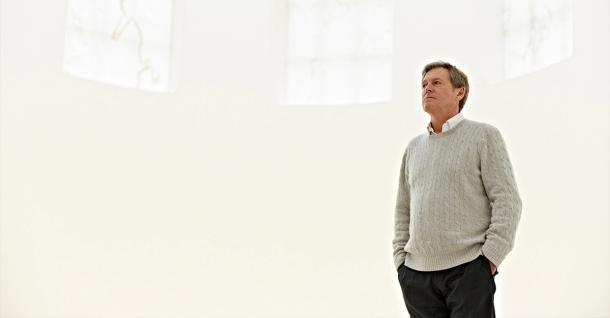
When is a little just enough? When John Pawson emerged in the 1980s, the idea of pared back minimalism was not as desirable as it has become. The architect and designer made the trend for ultra-lean linear whiteness, an emphasis on space and light, and the simple lack of stuff the norm. He has built monasteries, museums and bridges, written numerous books including a cookbook and a collection of his own digital photography and has quietly and unobtrusively become one of the most influential figures on contemporary aesthetics.
In person, he is charming, understated and dryly funny. His studio is in Kings Cross in London – he was one of the first to claim the area as a hub when most ignored it as a railway backwater.
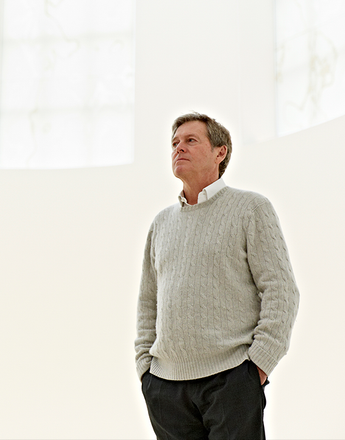
His pared down relationship to space and objects is reflected in his uniform of chinos, white shirt and a worn out but plush cable-knit oatmeal cashmere jumper. The roots of his view of the work began in Yorkshire. “We are from the West Riding -Halifax, and the Yorkshire Moors and the treeless landscapes. You’ve got the Peace Hall, Crossley Carpets, all made of this incredible stone. The simple architecture, and the Moors without trees must have had a very strong impact,” he considers. “My father would’ve loved to be an architect. He was always building things at the factory, and then orangeries and things like that. I think clearly being around, having builders all the time and plans, maybe that rubbed off.” His parents were primitive Methodists, so the idea of unadorned churches or meeting halls, even unaccompanied singing was part of his upbringing.
"For me architecture is anything where you put your hand to changing space, even if it’s an object. So it never bothered me that I started doing people’s flats, or interiors, or offices, or galleries – because it was London and most of those were readapting existing places."

John Pawson, Semaine Tastemaker
After leaving school he was unclear of his next steps, so went on trips to India and Australia rather than university. He worked for his father for six years before heading to Japan at the age of 24 inspired by a Tony Richardson film on the Zen Buddhist monasteries there. “I had a chance to escape and Japan was only the start really, but I never got any further!” he laughs. At that time in the 1970s, Japan was not that accessible or popular. “Most English people thought it was Hong Kong. They just though Japan was an island off China…” He lived there for four years (though only lasted in the monastery a night). “I’d seen 17th century films – samurais wandering around beautiful things, having tea ceremonies, so that’s what I thought it was. I was so naive and it was all over head cables and concrete boxes and I wasn’t even in Tokyo! I was in Nagoya.”
When Pawson returned to the UK and studied architecture, taking those Eastern influences into what became the mainstream transformed ideas of what architecture could be. That Zen-like approach to design and culture made a huge impact. People’s homes, galleries and desires have been transformed as a result of his view on light and experience in space.
A perfect example of how that still emerges in his work is his incredible design for the Feuerle Collection in Berlin. The space was created to house the collection of Désiré Feurle, a collector and dealer passionate about historical oriental art from the 6th century, Chinese furniture and contemporary art. “To actually get hold of a bunker at that scale is quite extraordinary.
It’s a single story above ground and the walls are three meters thick, and the ceiling is nearly four meters thick, of solid concrete.Of the highest is quality with the most amazing steel bars strengthening it. The columns are these incredible proportions. It’s all laid out in a really elegant way,” he explains. “The lower basement had been flooded by the canal next door, so looked amazing. We kept the feeling of an underground lake and just cleaned it up, which is a huge job.” The install of the collection, which begins with an entirely dark space and the music of John Cage, is strongly intertwined with the sense of the architectural space. It is undoubtedly one of the most beautiful and atmospheric private art collections to open this century.
In contrast Pawson also oversaw the very public Design Museum in London’s Holland Park, which instead of intimacy was created to work with a very large audience in a very open space. “The brief was quite programmatic,” the architect explains. “We knew what had to be fitted – two large exhibition rooms, four temporary shows, a permanent collection, the school stuff, the café, shop… The planning insisted that we kept the atrium near the original size. The opening night was a talk given by Terrence Conran to 11,000 guests! If you do a place, which attracts a million visitors in a year, you run the whole gamut of people’s expectations or requirements.”
The bread and butter of Pawson’s career has been adapting other buildings rather than creating from scratch but he still enjoys that process of adaptation. “I’m English. I started doing stuff in London in the late 70s, early 80s. For me architecture is anything where you put your hand to changing space, even if it’s an object. So it never bothered me that I started doing people’s flats, or interiors, or offices, or galleries – because it was London and most of those were readapting existing places.” His first house was in Majorca and the first monastery in the Czech Republic. He notably created Calvin Klein’s flagship store in New York, and has worked extensively with hotelier Ian Schrager.

A new hotel in Jaffa opens this year and a Schrager hotel in West Hollywood. Pawson won the Isamu Noguchi award in 2017, another designer and artist who crossed the borders between Eastern and Western aesthetics. Pawson’s practise keeps growing.
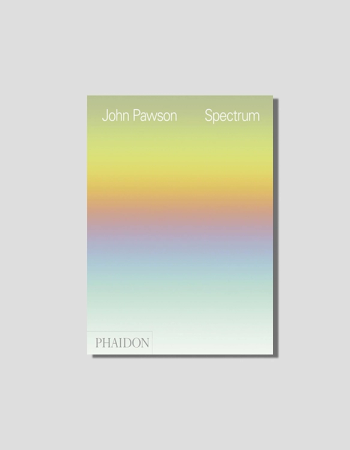
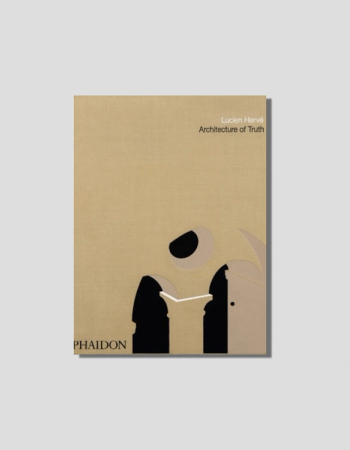
Buildings are not just the extent of Pawson’s work. His instagram, where he puts his images of architectural details and landscapes, is hugely popular with 125,000 followers. He has made six books with Phaidon. He has created cups and vessels, extension of whatever he approach to life is. “It’s nice to do new things. I tend to do things because either I’m asked or you kind of need them.
“I tend to do things because either I’m asked or you kind of need them. It’s not that I want everything to be my world or anything, but it is nice to see what effect they have on the architecture. Everything has an effect. If you’re offered a ballet set you say yes!”
It’s not that I want everything to be my world or anything, but it is nice to see what effect they have on the architecture. Everything has an effect. If you’re offered a ballet set you say yes!” Pawson created the set for Wayne McGregor one act ballet Chroma for the Royal Opera House, which has toured since 2006.
Pawson’s process is often brief responsive. “We’ve been very lucky because the sort of people who’ve come to us have already chosen beautiful places to put their houses, or interesting flats. It’s a balancing act because you have to obviously listen and be pleasant, but also get the atmosphere at the place. And I take a lot of photographs. You take everything, the village, the flora and fauna, the views.
You take literally hundreds of pictures and you listen to them and I write notes discreetly,” he explains. “They’re looking at you for the eureka, they’re wanting to see the creative genius, and of course sadly it’s all hard work and in applying yourself you’re sort of grinding away really. The great thing about architecture is that it’s very collaborative. We’re just building buildings.
There is an emotional side to the spaces Pawson create, and he is aware of that sense of feeling. “Most times people walk in to things we’ve done, and thank goodness, you can see a reaction. People do go “boo” or whatever they do. That’s how it’s supposed to feel. I think that’s the big litmus test for me,” he considers. “It’s a wow space in terms of subtle wow.”
By Francesca Gavin for Semaine.

Listen
Store
Travel

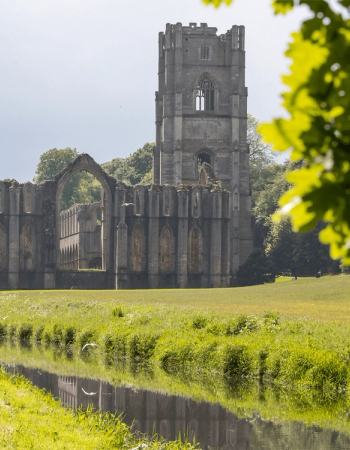
"The ruins speak to the beauty of impermanence and nature reclaiming space a dialogue between structure and landscape that resonates with Pawson's approach to architecture as living art".
Fountains Abbey
Fountains Abbey and Studley Royal Estate, Ripon, North Yorkshire, UK
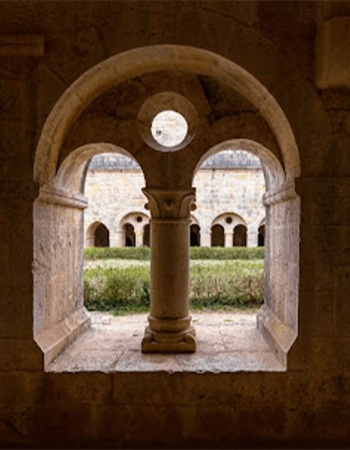
"A masterpiece of Cistercian simplicity, the Abbaye du Thoronet embodies pure, meditative space. Its minimalist stone architecture echoes John Pawson's pursuit of calm and essential form".
Abbaye du Thoronet
4540 Route de Montfort, 83570 Cotignac, France
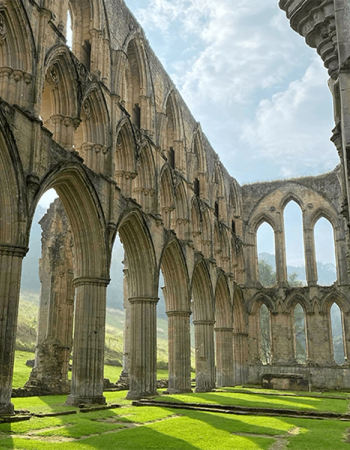
"A serene remnant of monastic life where minimalism meets history, Rievaulx Abbey's austere beauty is a quiet meditation on space, light, and material-core themes in Pawson's work".
Rievaulx Abbey
Rievaulx Bank, Rievaulx, Helmsley, York Y062 5LB, United Kingdom, UK
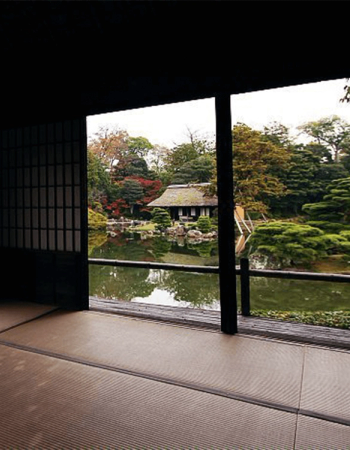
"This villa is a flawless example of refined restraint, where architecture, garden, and nature merge seamlessly— mirroring Pawson's dedication to harmony and simplicity".
Katsura Imperial Villa
Katsura, Nishikyo Ward, Kyoto, Japan
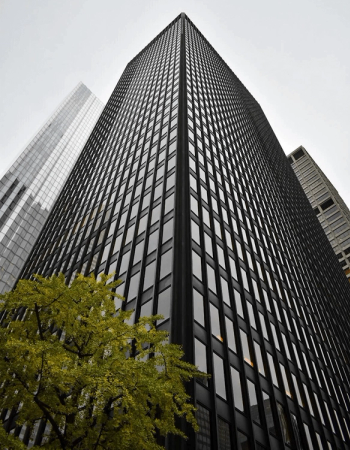
"The Seagram Building is a modernist icon whose understated elegance and precise detailing align with Pawson's ethos of less-is-more architecture".
Seagram Building
375 Park Avenue, New York, USA
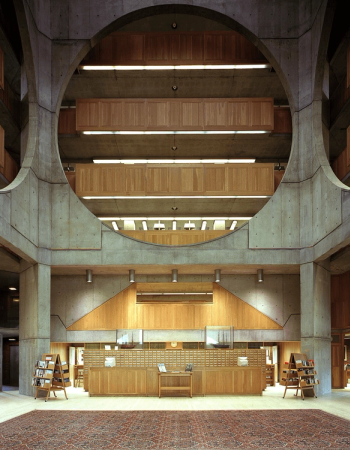
"Kahn's masterful use of natural light and pure geometry creates spaces of profound stillness and beauty-qualities that deeply inspire Pawson's architectural philosophy".
Louis Kahn Building
3333 Camp Bowie Blvd, Fort Worth Texas, USA

The vast, unadorned landscape of the Karoo Desert reflects the ultimate minimalism of nature itself-an endless horizon that invites quiet contemplation andy connection to place, much like Pawson's spaces.
Karoo Desert
Beaufort West, Western Cape, South Africa
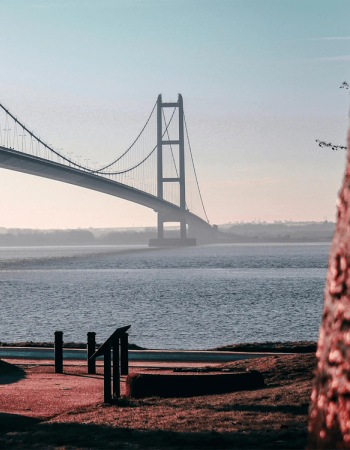
An elegant engineering feat, the Humber Bridge's clean lines and soaring cables reflect the power of minimal structural expression-an icon of purposeful design that Pawson admires.
Humber Bridge
Ferriby Road, Hessle, East Riding of Yorkshire, UK
Digest
Explore TasteMakers and TasteBreakers
- Alice Pilate
- Amanda Norgaard
- Ana Kraš
- Antonin
- Apollonia Poilâne
- Arman Naféei
- Athena Hewett
- Betony Vernon
- Cathrine Saks & Barbara Potts
- Charlotte Chesnais
- Claire Ptak
- Clara Luciani
- Daphne Javitch
- Dr Natazia Stolberg
- Dr Tara Swart
- Efe Cakarel
- Erchen Chang
- Francisco Costa
- Hans Ulrich Obrist
- James Massiah
- Julia Restoin Roitfeld
- Kengo Kuma
- Laila Gohar
- Lauren Levinger & Amrit Tietz
- Lucia Pica
- Luke Edward Hall
- Max Rocha
- Natalia Criado
- Noemi & Benjamin
- Padma Lakshmi
- Paris Hilton
- Paris Starn
- Ryan Gander
- Sarah Ben Romdane
- Shivas Howard Brown
- Sky High Farm
- Tonya Papanikolov